Small but Perfectly Formed

Monday, 22 September 2014

Baci di Dama
I had intended September to be all about biscuits ever since a friend at work told me that it was National Biscuit Month. Well, that clearly hasn't happened since we are now a third of the way through this very month and it is only now that I am posting a biscuit recipe. This month is actually an American celebration, and their biscuits are more like our scones, rather than the snack that you might dunk into your tea (or not). However, a small matter of  how a word is interpreted, or geography, makes no difference to me if it means I can bake.
I don't make biscuits that often, other than at Christmas (when I make a LOT) but I really wanted to bring you the most delicious, melt in the mouth, hazelnutty morsels, Baci di Dama, or, 'Ladies Kisses'. These biscuits are traditional to the Piedmont area in the northwest of Italy and are so named because the two halves are like lips kissing. The beauty of these is that they use very few ingredients - butter, sugar, flour, chocolate and hazelnuts - to make something truly special.
I think you all know by now about my love affair with almonds in a cake. Well, hazelnuts have the same effect on me in a biscuit. They have such a sweet, buttery flavour which works brilliantly with so many different other flavours such as chocolate, apples, raspberries and coffee, and that flavour and scent only deepens upon heating. 
Toasting and grinding whole nuts creates an infinitely superior product to pre-ground and when a biscuit uses so few ingredients, every one needs to count.
These biscuits are fairly simple to make if a little time consuming but don't let that put you off, as the results are worth it. Every step is there for a reason, so please don't be tempted to deviate from the method. The butter and dough have to be cold and the oven cool as it is this what ensures the balls sink into the characteristic domes to be sandwiched together. Dark chocolate is usually used for the filling, but since I had a great big jar of chocolate and hazelnut spread in the cupboard I used that instead, and it was perfect.


 For the biscuits
(adapted from food52.com)
100g whole hazelnuts, shelled and blanched
100g cold unsalted butter, cubed
100g caster sugar (I used my favourite golden caster sugar)
100g plain flour, sifted

For the filling
100g dark chocolate (melted and cooled), or 4tbsp of chocolate hazelnut spread

This recipe makes about 20 - 25 biscuits

1. Start by preparing the hazelnuts. Put them in a dry frying pan over a low heat and toast  
until they turn golden brown and start releasing their oils and fragrance, about 5 minutes. I would recommend that you stir the nuts while toasting to encourage even browning and
avoid burning, which can easily happen if you don't keep a careful eye on them.
2. Leave the hazelnuts to cool completely, place in a food processor and blitz until they are 
very finely ground.
3. Put the ground hazelnuts into a bowl with the sugar and flour and give it a stir to combine. Add the cubed butter and rub in until the mixture resembles breadcrumbs. 
4. Press the mixture together until you have a dough. You should find that it comes together very easily, and requires virtually no kneading. 
5. Wrap the dough in foil and put in the fridge for at least an hour, preferably overnight. 
6. Take the dough out of the fridge and roll teaspoons of the mixture into balls. Place them onto baking trays lined with baking parchment, a couple of centimetres apart, and return to the fridge for a further couple of hours. 
7. Preheat the oven to 150C, and bake the biscuits for 15 minutes until the balls have become domes. They should be pale in colour. 
8. Take the biscuits out of the oven and leave to cool completely on the baking trays so they become firm enough to handle.
9. To assemble the biscuits, using a teaspoon place a small amount of chocolate or spread on the flat side of one biscuit, and then top with another biscuit to make a sandwich.
10. Keep in an airtight tin for 4 - 5 days. If they last that long.


Hallo Autumn.....

Sunday, 7 September 2014

Bavarian Plum Tart (Zwetschgen Datschi)

....and goodbye summer. See you next year.
 
Autumn is probably my favourite season of the year. Not just because I am an Autumn baby, but also because I love the change in the light in the morning, the change in the colours of leaves on the trees, and layering up in cosy sweaters and scarves. And of course, it means that, (dare I say it), Christmas is not so far away.
With a new season brings seasonal produce to inspire my baking. Of course, you can buy most fruits and vegetables virtually all year round, but I much prefer to use them when they are truly in season. I like that it makes then certain cakes and bakes rather special as they can be seen as a representation of that season on a plate.
The one bake that absolutely signifies early Autumn to me is the delicious and very traditional Bavarian plum tart, known in Bavarian dialect as Zwetschgen Datschi.


Simply speaking, this tart is made from a yeast dough or sweet pastry, pressed thinly onto a baking sheet, covered with stoned and sliced plums and sprinkled generously with cinnamon sugar. When the plums cook the skin colour runs red and deepens and just looks so pretty.
Whenever I have visited Bavaria at this time of year, it is always what I have chosen from the bakery to have with my afternoon tea. What makes it so special is that the particular variety of plum used is only in season for a very short time. They are oval as opposed to round and have a very dark purple skin. I haven't seen them here in the UK, but while researching an equivalent, the Damson plum was suggested. However, I am not a patient sort and don't always have the time nor inclination to go a-hunting a specific ingredient when the same result can be achieved with an alternative. Therefore, I have used the darkest skinned plum that I could find for this tart. I would say though not to use the Victoria variety. Not because they are not delicious, and they are, but because their skins are not dark enough to give the colour that is so specific to this tart.
The recipe comes courtesy of my Grandmother, and I hope I have done it justice. She uses  the sweet pastry option for her version, for which I am thankful. Pastry I can make. Yeast dough is for me is......a little more of a challenge.
I hope that you give this a try and find it as delicious I do, and please, serve it with whipped cream. It is an absolute must. Lighter than double cream, it just works beautifully with this tart, and is how my Grandmother always enjoyed it.
 
 
 For the Pastry
300g plain flour, sifted
100g golden caster sugar
1 tsp baking powder
150g cold unsalted butter, cubed
1 large egg, beaten

For the Filling
500g dark skinned plums
1 tbsp demerara sugar
1/2 tsp ground cinnamon

I used a 9" loose bottomed square flan tin, greased, but you could just as easily use a swiss roll tin if that is what you have available.

1. Make the pastry by putting the sifted flour, caster sugar and baking powder into a bowl and stirring until combined. Add the butter and using your fingertips rub in until the mixture resembles fine breadcrumbs.
2. Make a well in the centre, add the egg and stir using a fork until the mixture starts to come together. Using your hands, press it into a dough. 
3. Form the dough into a ball, wrap in foil and place in the fridge for a couple of hours to rest.
4. Take the dough out of the fridge and allow it to come back to room temperature.
5. Put the dough into the centre of the prepared flan tin and press it down using your hands so it evenly covers the base and sides of the tin. Put the tin in the fridge while you prepare the plums.
6. Preheat the oven to 180C / 350F / Gas 4
7. Cut each plum in half, remove the stone and then cut each half into 4 and so that each plum gives you 8 segments.
8. Lay the plum segments lengthways across the pastry base in rows until all they all are used up.
9. Mix together the Demerara sugar and cinnamon and sprinkle liberally over the plums.
10. Put the tart into the oven and bake for 25 minutes until the fruit is cooked and the pastry is golden brown.
11. Cool in the tin before removing the tart. 


Baking Notes
If you want to make the pastry ahead of time then you can, as I did. I made the pastry the day before I made the tart and put it in the fridge. The next day I took it out and brought it back to room temperature before using it, which caused it no harm at all. You could also make the pastry in a food processor if you prefer. Just put the dry ingredients into the processor bowl, and the butter and whizz them altogether until you have the requisite fine breadcrumbs. Add the egg and pulse until a dough just starts to form. Then take it out and continue with the method from step 2.


A Taste of Provence

Wednesday, 6 August 2014

Lavender, Lemon and Honey Cake
(adapted from Love, Bake, Nourish by Amber Rose)

Lavender. I have bathed in it. I have scented my house with it. I have even spritzed my laundry with it, but, I had never tasted it. It is a flavour that had always intrigued me as I thought that it might be akin to eating a bar of soap. Which, when I recently tried some (bought) lavender shortbread, it was. I have to say that it was a flavour that I didn't think that I would be hurrying to try again as I found it quite unpleasant. So much so that my biscuit remained unfinished. 
However, that opinion changed when I saw this cake. Although lavender, the lure of the other ingredients proved strong enough for me to want to give it a try. There is something about cakes that include almonds that I love. Perhaps it is the taste, or maybe it is the squidgy dampness that they impart that I am addicted to. I don't know what it is, but if a cake is heavy on almonds then I am a fan. Polenta is used in place of flour in this cake which, being made from corn, makes this cake gluten free, and therefore perfect for those who cannot eat wheat or are trying to reduce it in their diet. 
This cake is my first foray into a beautiful book called 'Love, Bake, Nourish' by Amber Rose, which had been on my radar for a while, and which I finally acquired only recently. If you like cakes and baked goodies that use seasonal ingredients and healthier and nutritious alternatives to refined sugar and wheat flour then this book is for you. 
The recipes are not vegan as they do use butter and eggs, but instead of white sugar you will find honey and maple syrup, and in place of wheat, nut, buckwheat, and spelt flours.
It is an amalgam of two recipes, the cake being from one, and the icing, another. Of course there is nothing to stop you from just making the cake au naturel, but I just think a little adornment stops it from looking naked.


So, how did the cake turn out? Very well indeed! It is very soft and moist, which is to be expected  from all of those almonds, and the polenta adds an unusual crumbly grainy texture, which I found rather moreish. It is also beautifully light and two pieces are easily wolfed down without realising it (or feeling guilty).
However, I cannot say that I really tasted the lavender. Perhaps I chopped it too small, or maybe I should have been brave and used a little more. I am not sure until I make it again and tweak the amount. What does come through though is the lemon (which is always a good thing in my opinion) and there is no reason why you couldn't replace the lavender with extra lemon zest, or replace the lemon with orange zest and juice. You could even go one step further and use a mixture of both to make a super-citrusy cake.
 

For the cake
2 teaspoons dried lavender, finely chopped
100 g golden caster sugar
225g unsalted butter, softened 
225g ground almonds
1 tsp vanilla extract
3 large eggs
Grated zest of 2 unwaxed lemons
Juice of half a lemon
75g honey
110g polenta
1/2 tsp baking powder (Dr. Oetker make a gluten free option if wheat cannot be eaten)
Pinch of salt

For the icing
30 ml lemon juice 
3 tsp honey
125g icing sugar
1 - 2 tsps dried lavender, chopped

Preheat the oven to 160C.
Grease and base line a 20cm loose-bottomed cake tin with baking parchment.

1. Cream the butter, sugar and lavender in a large bowl until very pale in colour and fluffy in texture. I usually whisk with an electric mixer for about 5 minutes for the mixture to get to this stage.
2. Add in the ground almonds and vanilla extract and stir until incorporated.
3. Beat in the eggs, one at a time until well mixed, and then gently fold in the zest, juice, honey, polenta, baking powder and salt with a metal spoon.
4. Pour into the prepared tin, and with the back of a spoon level the surface.
5. Put in the oven and bake for 45 minutes until a cocktail stick comes out clean when inserted in the centre.
6. If you think the cake is becoming a little brown, cover the surface for the last 10 minutes of cooking with a circle of greaseproof paper.
7. Take the cake out of the oven and leave in the tin for about 15-20 minutes before turning out onto a cooling rack to cool completely. Remove the baking parchment layer.
8. To make the icing, mix the lemon juice and honey in a medium sized bowl, and add in the icing sugar in two batches. What you are aiming for is a thick icing that can be poured and drip prettily down the sides.
9. Spoon over the cake and sprinkle with the chopped lavender.
10. If you wanted to, make this the day before you need it and wrap it in greaseproof paper and foil, un-iced, and it will be even better for it.


From my Grandmother's Table

Sunday, 13 July 2014

Kirsch Kuchen (Cherry Cake)
I was recently in Germany for a whistlestop family visit. As is usual with my family (and I am sure, many others) no sooner had we walked in the door on the afternoon of our arrival, then we were sitting down drinking coffee and eating cake. And no sooner had we finished that, we were sitting down to a traditional, and very delicious, Bavarian meal prepared by my cousin. Sausages, cucumber salad, warm potato salad (the German kind made with hot vinaigrette, not the American version. Far too heavy on the mayonnaise for my liking), rye bread and German mustard were on the menu, all washed down with a beer. It was a very wonderful welcome.
I only tell you this as it reminded me of all the times I spent visiting my Bavarian grandparents, when every day revolved around food. First there was breakfast, then elevenses, lunch, a spot of kaffee und kuchen in the afternoon, and if we were still hungry after all of that, there was a light supper. Not surprisingly, I always came back from my German holidays a few pounds heavier.
However, although we ate cake, pudding was rare. Maybe occasionally some gelato from the Italian ice cream parlours that are on every corner during the summer, but mostly we always had fruit, and it was no different during my recent visit.
On the table was a large dish of the biggest, plumpest, reddest and juiciest cherries I have seen in a long while. This got me very excited as I absolutely love cherries. They are by far my favourite summer fruit, and I can happily chew (and spit) my way through a punnet or two with ease.


Seeing these cherries reminded me of a recipe for Cherry Cake that I had seen in my grandmother's handwritten cookery book. She was a fantastic cook, and at some point in the early sixties she wrote her own personal recipe book. All categories were covered, from cakes, puddings, and Christmas baking, to savoury starters, main courses and drinks, all written in her beautiful handwriting.
My mother now has the book in her possession but I have borrowed it for inspiration. It is funny, but in all the years I have been baking, I don't think I have ever baked anything German, other than the goodies I bake at Christmas. Perhaps it is because my mother always made her mother's recipes, and so I never felt the need to.


However, I don't think she ever made this one, and as we are in cherry season, it was the perfect time to give this cake a try. I have made a couple of changes to the recipe and added a few more details that were missing from the original version. My grandmother wrote a wonderful book, but reading it, well, you can tell that she wrote it for herself, as on occasion the methods are a little vague. For example: make the batter, put in a cake tin, bake for an hour.
Yes, that is all very well, Granny, but HOW do you make the batter? WHAT size should the tin be?, and at WHAT temperature?! You see, vague.
This is a super cake, very light, and not at all dry. There is a background note of lemon, but this could easily be replaced with almond extract if you wish since almonds and cherries are perfect partners. I was tempted to do this, but as this is my grandmother's recipe, it is only right that to do it justice I should follow the recipe as written. What did surprise me about this cake is that in my opinion, it has a 'German' flavour. I wish I could explain what that means, but I don't think I can. Perhaps it is just knowing the cake's history that it makes sense that it should taste of her homeland.  


For the Cake
200g unsalted butter, softened and at room temperature
200g icing sugar, sifted
200g self raising flour
4 large eggs
zest of 1 lemon (or 1 tsp of almond extract)
450g cherries, stoned and kept whole if possible (see the notes below)
Icing sugar for dusting

You will also need a 22cm (8 1/2") springform tin, greased and base lined with baking parchment

1. Preheat the oven to 160C / 150C fan / 325F / Gas 3-4.
2. Beat the butter and icing sugar together until very fluffy and pale in colour, about 4-5 minutes.
3. Beat in the eggs one at a time with a tablespoon of the sifted flour to prevent curdling.
4. Beat in the lemon zest and then fold in the flour gently. Don't over beat as you want to keep in as much air as possible. Once all of the flour is incorporated, stop mixing.
5. Put half of the mixture in the prepared tin, and then lay the cherries in one layer over it. They will sink to the bottom but don't worry about this.
6. Cover the cherries with the remaining mixture and level the surface. 
7. Bake for 50 minutes to an hour. My grandmother says to bake for an hour, but mine was ready in 50 minutes. Therefore you could open the oven door after 50 minutes if you wish, to check if it is done, and if not, then every 5 minutes or so until a skewer or cocktail stick comes out clean.
8. Take the cake out of the oven and leave it in the tin for 15 minutes. Remove from the tin and put onto a cooling rack. I would add to be careful with the cake as it is quite delicate while warm.
9. When the cake is cold, drench in sifted icing sugar and devour. I recommend with some whipped cream!


Baking Notes
Stoning cherries is very laborious and very dull, and unless you have time on your hands I would strongly suggest that you use a cherry stoner. I cannot say that it makes the job any more interesting, but it certainly makes light work of it, and keeps the fruit whole, which adds to the look of the cake when cut. Feel free to use tinned cherries (in juice, not syrup), or those in a glass jar, but do make sure that they are very well drained before you use them, and any excess liquid removed with kitchen paper. 


Eng-er-land, Eng-er-land!

Thursday, 12 June 2014


Vanilla Cupcakes
It can't have escaped anybody's notice that the 12th June 2014 saw the start of the month long '22 men kicking a football around on a green pitch' marathon, otherwise known as the World Cup. To be honest, I have very little interest in 'the beautiful game', but when it comes to this tournament, I can get as excited as the next person. Maybe it is because it comes around only every four years and therefore makes it something special, or maybe it is because I just enjoy all of the razzmatazz that goes along with it. I suspect it is the latter.
It is the only time in which I will actively sit and watch a football match, even though I couldn't tell you the finer points of the game, and please don't ask me about the offside rule! Not every match however, only those in which my two teams of England and Germany are playing. Of course I would like both to do well, but I think I can safely say that one team will get much further than the other, and won't go out on penalties. However, should both teams play one another, then I become like Switzerland. In other words: neutral. It is the only way not to upset either parent.
As I think you all may have realised by now, I do like a theme, and something, anything, makes me want to celebrate it with something sweet. Therefore, why not mark the occasion of the World Cup with a cake? Or more specifically, represent your favourite team's colours in edible form? I chose the English flag over the red yellow and black of the German because the colours are prettier and, if I am honest, I prefer it.
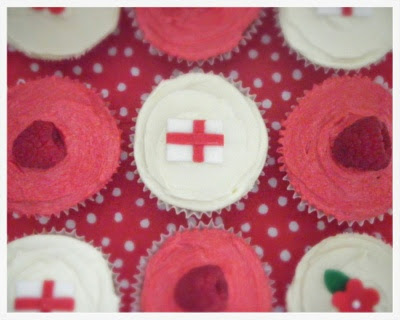
I chose cupcakes simply because I thought I could have a bit of fun decorating them. Mini fondant flags, red flowers (not quite the red rose of England, but you get the idea), and red and white buttercream sitting atop a vanilla cupcake is my interpretation.


To be honest, I don't make cupcakes very often, but there is definitely a place in mine, and your baking repertoire for a good, simple vanilla cupcake and buttercream, which you can make to celebrate any occasion. These are my favourite recipes out of all of those I have tried over the years, and are actually fairly recent discoveries. Why? Because the cakes are light, moist, and delicious with vanilla, and the buttercream, although sweet, is not so sweet that you have to leave it uneaten on the plate. 
I think I first became aware of the cupcake during an episode of the New York set, US 
comedy show 'Sex and the City' when two of the characters, Carrie and Miranda, were munching on one outside of the now famous Magnolia Bakery. This was like the dainty British Fairy Cake on acid. It was huge. Triple the size of said Fairy Cake with buttercream so high that it had to be eaten sideways if you didn't want your nose in it. This episode was at least 10 years ago, and with like so many things Stateside, the cupcake landed on our shores and never left.
My feeling is that often they promise much more then they actually deliver. I have bought many a cupcake (and from well known bakeries) in the name of (ahem) 'research', but often I am disappointed. The cake is either too dry, or tastes of.....not much, and the amount of buttercream is too much, and so sweet that it is rendered inedible. But, they always look so beautiful, and the flavours so enticing that it is hard to resist that little piece of indulgence. And I know that I will always keep on 'researching' in the hope that one day, the taste will match the look.
My preferred cupcake option is therefore more cake with enough icing to set off the decoration. I would say that my piping skills (in the words of many a school report) are satisfactory, at best, so I take the alternative option of using a small palette knife with which to spread on the buttercream. My cupcakes will therefore never look like those in the bakeries, but there is nothing wrong with that homely artisanal look. Indeed, they can look just as inviting as those professionally finished.


For the Cake

This recipe will make 24 cakes

250g self raising flour
250g golden caster sugar (or use regular white caster sugar)
1/2 tsp bicarbonate of soda
250g unsalted butter, softened
4 large free-range eggs, at room temperature
1/2 tsp vanilla extract
3 tbsp whole milk, at room temperature
Preheat the oven to 170C (fan) / 375F / Gas 5
Line a 12 hole muffin tin with your choice of cupcake cases

1. In a large bowl sift together the dry ingredients, and then add in the butter and eggs.
2. Mix together until well combined, but don't over mix, and then add in the milk and vanilla extract and  beat again until all mixed in.
3. Fill the paper cases about 2/3 full with the cake mixture and bake for 20 minutes until they spring back when touched. I also insert a cocktail stick and if it comes out clean then it is cooked.
4. Leave to cool in the tin for 5-10 minutes and then put on a wire rack to get completely cold before decorating.


For the Vanilla Buttercream
300g unsalted butter, at room temperature
1/4 tsp vanilla extract
4 tbsp whole milk, at room temperature
675g icing sugar, sifted

1. Put the butter into a large bowl and using an electric mixer beat for 5 minutes until it becomes very soft, pale and fluffy.
2. Add the icing sugar in 3 batches, beating well after each addition, and then mix in the milk and vanilla extract.
3. Beat for a further 5 minutes until the icing is very smooth, and again, very pale (almost white), and fluffy.
4. Decorate the cakes with the icing either using a piping bag and nozzle or a small knife.


.

Baking Notes
Having made these two recipes a few times now, I would say that for best results, the butter needs to be very soft in both cases for two reasons:
1. The cake is made by the all in one method and soft butter will enable you to mix it in super easily.
2. The softness of the butter is crucial to a smooth buttercream. You may think that to beat the icing for what seems like an eternity is unnecessary once all the icing sugar is mixed in, but please don't omit this stage as it is the only way to ensure a light, airy and fluffy (almost whipped in texture) buttercream, which is just as lovely to use as it is to eat. 
If you try these cupcakes, I would love to know what you think of them, and how you decorated them.

A Taste of Eastern Promise

Sunday, 1 June 2014

Pistachio and Rosewater Cake
(adapted from RedOnline here)

I cannot tell you how excited I am to share this Middle Eastern inspired cake with you. I think it is one of the prettiest cakes that I have seen for a while and it is my way of heralding the start of Summer.
When I found it amongst my recipe file, I just thought, 'oh hello.....you look tasty, come into my kitchen!'
I love all things pistachio (its ice cream is my favourite), and I love the rose flavour of Turkish Delight. Throw in some pink from the rose petals, and combined in a cake, it just had my name written all over it. However, I have never baked with this classic combination before so I was intrigued to find out if it would live up to my expectations.
It did, and I was so pleased. While the cake was baking, the most delicious scent of rose and lemon filled my kitchen, and when cut into it, that same scent was intoxicating.
The rose flavour was very delicate, (not at all like ingesting a mouthful of  perfume) and mixed with the sharpness of lemon, the cake was so moreish. The pistachio nuts give a slight green hue to the cake, and a creamy nuttiness. You will find this cake very moist because of the oils in the ground almonds, and its taste and texture improves with age. Therefore, if you make this cake, I would recommend that you do so a day or two in advance for maximum impact! 


 For the cake
225g butter, softened (and a bit extra with which to grease the tin)
60g corn flour (I was a bit sceptical about this, but its addition gives a lovely crumbly lightness) 
1 tsp baking powder
100g blanched almonds
125g unsalted shelled pistachios
225g caster sugar (I used white instead of my usual golden because that is what I had in the cupboard)
3 large eggs
Juice and zest of 1 lemon
2 tbsp rose water

To decorate
Icing sugar
25 - 50g chopped pistachios 
2 tbsp edible dried rose petals (I found mine in Waitrose, but they are available online)

To serve
Greek yogurt mixed with lemon curd

23cm 9" springform cake tin, greased with butter and base lined with a circle of baking
parchment

1. Preheat the oven to 160C/325F/Gas mark 3
2. In a dry frying pan toast the almonds and pistachios in a until they have gained a little colour and the and you can begin to smell them. Do be careful to keep an eye on them and stir them occasionally as the almonds can easily get too brown and burn. Don't be tempted to miss out this step as the toasting really helps with developing the nutty flavour.
3. Put into a food processor and grind very finely.
4. Mix the butter and sugar in a bowl until very light and fluffy, about 4-5 minutes. Add the eggs one at a time, mixing well after each one, and then add the lemon juice, zest and rosewater.
5. Sift together the flour and baking powder. Add to the butter, sugar and egg mixture and fold in gently until well combined. 
6. The mixture should be a soft dropping consistency. If not, add a little more lemon juice until it is.
7. Pour into the cake tin and bake for 40 - 50 minutes until a skewer comes out clean and the top is golden brown. If you think that the top of the cake is becoming too brown while baking, just put a layer of greaseproof paper over it. 
8. Take the tin out of the oven and leave to cool down for about 10 to 20 minutes for before removing from the tin and placing on a cooling rack. Do be careful at this stage though, because the cake is quite delicate and liable to break in half if you pick it up on either side. I would recommend a fish slice to slide under the bottom of the cake to help move it.
9. Dust with icing sugar, sprinkle either delicately, or liberally with the chopped pistachios and dried rose petals.


 If you try this cake I would really like to know how you like it. Or, do you have a recipe that you make that says 'Summer' to you?

A Show about Cake

Saturday, 31 May 2014

In April I took myself off to the Cake International show at the London Excel Centre (only to be met by not just fellow enthusiastic bakers, but also by a few thousand marathon runners, registering for the 26.2 mile challenge of endurance. It was the day before, after all).
It was the first time I have been to such a show, and I must say, I had a thoroughly wonderful time. Being in a place which is dedicated to baking and decorating, with a whole myriad of goodies to see and buy, is my idea of heaven. It is my equivalent of a child being in a sweetie shop. These kind of shows serve as inspiration because the products on offer can open up a whole world of ideas to try. I made a few purchases, but honestly, I could have gone home laden down with bags full of treasures!
However, I showed remarkable constraint, and took home with me what I knew would be most useful now, and in the near future.
Unbeknownst to me, there was also an exhibition of decorated cakes made for competition, which was a lovely surprise. Oh my, there is so much talent and creativity in this country. I was in absolute awe at some (well, actually all) of the cakes on show, and below are my personal favourites that I wanted to share with you.


  An idea for next Easter
Beautiful Wedding cakes.....
.....and wedding favours


Two of my favourite stalls


And what came home with me.....

I hope you have enjoyed my little resume of my day out, and I am already looking forward to the next show.